

Q: How do I know if injection molding is the right process for my product?
A: The geometry of the part, the amount of parts needed, your tooling budget and the application the part is being used for will all influence your decision to injection mold the part.
Q: What type of information is required for quoting a molding project?
A: Please complete our initial RFQ form. After that we'll need more specifics like the annual quantity needed, material preference, part prints or CAD files, part samples (if available), description of part application, time frame for prototype parts, and time frame for production parts.
Q: What are your criteria for a new molding project?
A: Since we are a high volume molder, we require a minimum of 1 milllion parts, an item that can be made using the injection molding process as well as an item that can be made from a material that can be injection molded.
Q: What part size limitations do you have?
A: Generally, not much bigger than 10" x 10" x 10". Our specialty is small parts in the range of 3" x 3" x 3" and smaller.
Q: What material should I use for my project?
A: Most material is application specific. If you don't have a material selected for your application, we can help and offer some guidance. Often several resins can be sampled, but the customer has final approval before proceeding.
Q: What is the typical process of a new project?
A: We will evaluate your part design and modify it to be efficiently injection molded. Then, we will build the mold for the part. Next, your mold will be put into an injection molding press to make production parts.
Q: How long does it take to build an injection mold?
A: It depends on the complexity of the parts. Simple molds can be completed in two weeks. More complex molds could take several months. At The Rodon Group, we precision build molds that will last under the pressures of a high production environment.
Q: Do you offer prototype tooling?
A: Yes, but only to evaluate the prototype part prior to producing production tooling. We do not build prototype tools as a service. We are a high volume molder and the amount of production parts from a prototype tool is limited.
Q: What types of molding services do you offer?
A: We produce high volume production parts (1 million), we design the mold for production, make the mold, and run production parts.
Q: How can you beat China pricing?
A: Globally competitive prices and elimination of offshore risks add up to a delivered part price that makes Rodon the envy of our industry throughout the world. See our Cheaper than China comparison chart to see how "Rodon Beats China Pricing" and why we're your best choice for high-volume, custom plastic injection molding.
Q: Do you offer a standard parts line?
A: Yes, we have an assortment of standard caps, plugs and fasteners as well as hose washers. You can reference our complete line of standard products through our online catalog.
Q: What is your maximum part size and press capacity?
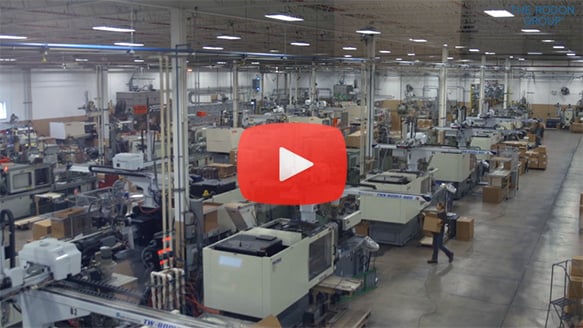
A: We specialize in high-volume, small-to-medium-sized parts. Our maximum part size is a 10-inch square. Mostly our parts are 3″x3″x3″ and smaller. To support this, our facility operates 120 fully automated presses with clamping forces ranging from 46 to 720 tons, and shot capacities ranging from fractional up to 107 ounces.
Q: Can you accommodate complex geometries and varying wall thicknesses in your mold designs?
A: Yes. Our toolmaking team utilizes advanced design software (such as SolidWorks) to analyze and optimize part designs prior to cutting steel. Our precision molds are engineered to manage complex geometries, achieve tight tolerances, mitigate warping in parts with wall thickness variations, and optimize cycle times for high-volume production.
Q: Do you offer cleanroom injection molding for medical or food-grade applications?
A: Yes. We operate a new, adaptable Class 8 Cleanroom environment within our facility. This allows us to manufacture components in a sterile, contaminant-free setting that adheres to strict FDA, medical, pharmaceutical, and food and beverage regulatory standards.
Q: Who owns the mold, and what are the maintenance costs over its lifespan?
A: The customer owns the mold. However, as part of our turnkey manufacturing approach, Rodon offers a unique, lifetime tool warranty. As long as we are operating a tool that we have manufactured in-house, you will never incur any maintenance or repair charges for the life of that project.
Q: How do you handle inventory management and mitigate supply chain disruptions?
A: As a 100% U.S.-based manufacturer (Hatfield, PA), we inherently reduce the risks associated with offshore shipping delays. To further protect your supply chain, our automated facility runs 24/7. We utilize a Material Requirement Planning (MRP) System and monitor inventory levels in real-time, allowing us to maintain safety stock and rapidly respond to unexpected spikes in your demand.
Q: What quality control standards and certifications do you hold?
A: We maintain a 99.8% customer satisfaction rating through rigorous, multi-phase quality control checks (assessing tolerances, strength, color accuracy, and defects). Our manufacturing processes are formally backed by ISO 9001:2015 and ISO 13485 certifications, ensuring consistent, high-quality production across all industries.
Q: Is plastic injection molding the most cost-effective method for our production volume?
A: For high-volume production, custom plastic injection molding is highly cost-effective. While the initial investment in precision toolmaking is significant, the per-part cost drops dramatically at scale. The process offers high efficiency, rapid production cycles, high consistency, reduced material waste, and lower labor costs compared to other molding methods.
Q: How does partnering with a U.S. manufacturer like Rodon impact our overall ROI?
A: Reshoring or partnering with a domestic manufacturer like Rodon improves ROI by eliminating international freight costs, reducing lead times, and bypassing tariffs and complex customs logistics. Furthermore, our highly automated facility - running 125 presses 24/7 - allows us to offer highly competitive, high-volume piece-part pricing while maintaining strict U.S. quality standards and IP protection.
Q: Do you offer post-molding assembly services for multi-part plastic components?
A: Yes. To provide a complete, turnkey manufacturing solution and streamline your supply chain, Rodon offers both semi-automated and fully automated high-speed assembly services. The ideal assembly approach depends on the specific nature of your part, annual volume requirements, and component complexity:
- Fully Automated High-Speed Assembly: Ideal for ultra-high-volume, highly repeatable projects where maximum throughput, cycle-time minimization, and strict consistency are required.
- Semi-Automated Assembly: Best suited for projects requiring a blend of robotic precision and operator inspection, or for complex geometries that benefit from flexible, human-assisted placement.
Integrating custom assembly directly at our facility eliminates the need for third-party secondary processors, lowering your total cost per part and reducing shipping delays.
Resource Library
Our Capabilities